So, how do you break through the noise when the whole world is shouting?
The answer lies in a fundamental shift in how we view influencer marketing: we must stop treating creators as mere amplification tools and start building immersive “Physical-Digital Ecosystems” where brands, creators, and fans can co-create in real-time.
The trap of manufactured relevance
For years, the marketing industry has fallen into the trap of confusing “cultural relevance” with simply jumping on the latest TikTok trend or borrowing a popular meme format.
As highlighted in SAMY’s Social-First Manifesto, when every brand strives for the exact same trending topics, they blend together, undermining the very reason brands exist: differentiation.
To truly matter in the social universe, a brand cannot just broadcast a message; it must facilitate a shared experience. We knew that for the 2026 World Cup, attention would not be won simply by talking about the game, but by physically and digitally being where the story was happening.
As our Chief Strategy Officer, Alex Hill, points out, “to build meaningful relationships and connections, we need to stop thinking ‘advertising first’, and start thinking ‘human first’.
This mindset echoes the core philosophy of our Co-Founder, Marta Nicolás: “We claim to be social-first… but that’s not happening if we are not human-first, right?”.
This was the strategic foundation for our latest and most ambitious campaign: the Super Kwai Arenas.
Building the Super Kwai Arena: a real-time content factory
Partnering with the short-video platform Kwai and sponsored by Superbet, we set out to create the largest hub of Brazilian content and entertainment in the United States during the World Cup. But we didn’t just want to throw a massive watch party. We wanted to build a living, breathing ecosystem.
We established two premium physical spaces at the epicenter of the Brazilian diaspora: The Assembly in Midtown Manhattan, New York, and American Social in Brickell, Miami. These venues were transformed into state-of-the-art “Content Factories.”
Instead of simply installing big screens for the matches, we created immersive fan experiences with dynamic broadcast sets, high-performance Wi-Fi, fully equipped podcast studios, and complimentary premium food and beverage service—allowing every guest to enjoy the experience at no cost while turning every matchday into a hub for content creation, connection, and celebration.
We then invited a meticulously curated community of over 50 elite creators, celebrities, and football legends to inhabit these spaces. Together, this roster represented a combined social media audience of more than 20 million followers, amplifying every moment of the experience far beyond the venue itself.
The magic happened at the intersection of the physical (IRL) and the digital (URL). By putting these distinct voices into a highly charged, authentic environment, we removed the sterile nature of traditional brand sponsorships. The creators weren’t handed rigid scripts; they were handed a playground. They fed off the live energy of the matches, the reactions of the crowd, and the spontaneous interactions with each other.
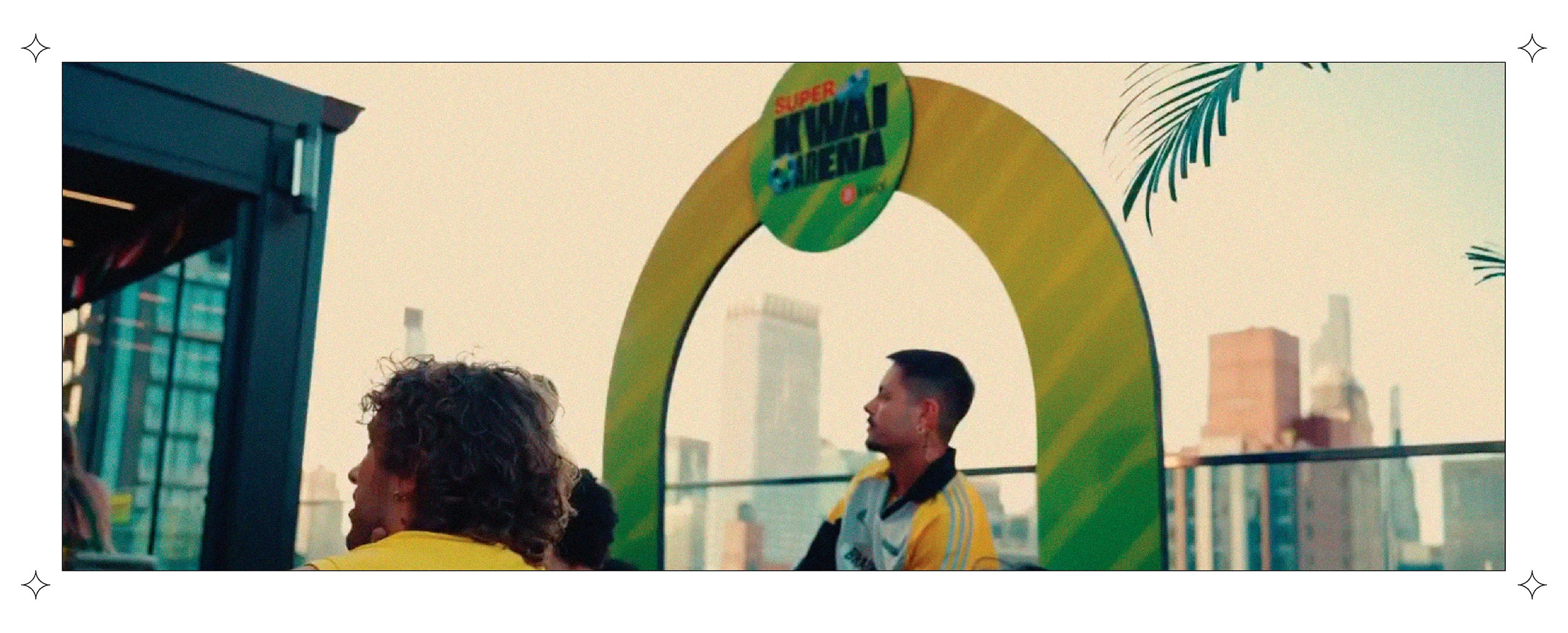
SAMY set out to build the largest hub for Brazilian content and entertainment in the U.S. during the World Cup. Not just a watch party, but a living, breathing ecosystem.
The Results: when authentic integration outperforms paid reach
When you allow creators to operate authentically within a shared, dynamic environment, the results speak for themselves. In a highly saturated World Cup landscape, the Super Kwai Arena campaign shattered benchmarks.
Across the New York and Miami arenas, the ecosystem generated 2.8K pieces of unique content. This content drove an astounding 102 million views and 4.7 million direct interactions. Perhaps most impressively, the campaign achieved a massive 4.6% Engagement Rate—a near-impossible feat during a global sporting event when audience attention is aggressively divided.
Individual creator performances proved the power of context. Comedian and creator Ítalo Sena generated 12.6 million impressions alone, while lifestyle creator “Uma Lituana Pelo Mundo” brought in 5 million impressions, and fitness influencer Toguro added another 3.6 million.
Creators post not because you obligate them to, but because you give them an experience that delivers undeniable cultural currency.
Crucially, when we analyzed the source of these impressions, the data validated our core thesis. While paid Kwai and Superbet influencers performed exceptionally well, the vast majority of the reach came from organic, non-paid influencers who were simply invited to experience the space.
They posted not because they were contractually obligated to, but because the physical experience provided them with undeniable cultural currency. Over 1000 guests flowed through the doors of our arenas, transforming their offline experiences into digital advocacy.
Implications for decision-makers: what CMOs must do next
The success of the Super Kwai Arena provides a clear blueprint for the future of influence. For CMOs looking to stay ahead of the curve and turn cultural moments into lasting brand equity, here are the non-negotiable strategic shifts you must make:
- Shift from Broadcasting to Co-CreationThe era of the transactional brand-influencer relationship is over. Consumers no longer separate entertainment from shopping or content from advertising. Stop paying creators just to hold your product in front of a ring light. Instead, integrate your brand into their creative process. Provide them with the tools, the access, and the freedom to interpret your brand through their unique cultural lens. As our Global Chief Creative Officer, Santiago Lucero, notes, “creativity is the only thing that can turn a product into a shared experience”.
- Stop Buying Reach; Start Cultivating CommunitiesReach is a commodity; community is an asset. The traditional funnel built around siloed awareness campaigns is dying. Brands must focus on building ecosystems where fans feel a sense of belonging. When you create spaces where belonging, participation, and play come alive, consumers transition from passive viewers to active brand advocates.
- Merge the URL with the IRLThe digital world craves physical validation. As we saw in NYC and Miami, community is no longer a passive brand value—it is a practice that happens in the real world. Pop-ups, live studios, and experiential hubs give digital creators the contextual canvas they need to tell better stories. The physical space creates the organic friction and spontaneous moments that make digital content feel raw and real, cutting through the polished, AI-generated noise of modern feeds.
- Measure Emotional Resonance, Not Just Vanity MetricsLikes and shares are the baseline, but they do not tell the full story. As the algorithmic landscape evolves, brands must prioritize emotional connection and brand affinity. The true measure of a campaign’s success is whether it made the audience feelsomething. Are you adding value to the community’s conversation, or are you just interrupting it?
The future is human-first
The Super Kwai Arena proved that the most powerful experiences are built around people, not just platforms.
More than a venue to watch football, it became a space where connections happened naturally. Brazilian fans found a place that felt like home, creators who had only interacted online finally met in person, and new friendships, collaborations, and business opportunities emerged throughout the tournament.
In the end, what truly breaks through the noise of a major cultural moment is not the size of the media buy, but the depth of the human connection. Algorithms may drive distribution, but people create relevance—and that’s exactly what the Super Kwai Arena was designed to do.
As Santiago Lucero powerfully reminds us, “before being Social First, we must be Human First”. The future of influencer marketing does not belong to the brands that shout the loudest. It belongs to the brands that host the best party, open the doors wide, and let the creators and the community write the story together.