People still open the app to search. But underneath that search, the model isn’t hunting for a face. It’s hunting for consensus. So here comes the new CMOs’ obsession, and it’s moving through boardrooms faster than almost any platform shift before it.
Marketers everywhere are opening their LLM of choice, ChatGPT, Claude, Gemini, and asking it to recommend products in their category. When their brand doesn’t show up in the answer, something close to panic sets in, and the pivot is immediate:
YOU ASK: “How do we get recommended, get cited, get crawled in LLMs?”
Brace for a wave of budget, over the next year, chasing exactly that.
The new gatekeeper: Why AI is rewriting the rules of marketing
We’ve watched this exact reallocation happen before, more than once, and the data traces it almost too neatly. When Google was king, SEO absorbed the obsession, and the org chart followed. Then social took the crown: by 2025, 81% of marketers were already pulling budget out of traditional SEO to fund organic social, paid social, and influencer partnerships, not new money, reallocated money.
Marketing de influência rode that same wave from roughly $1.7 billion in global spend in 2016 to a projected $20 billion-plus in 2026.
Each time, the newest channel absorbed a disproportionate share of attention and budget, and each time, the brands who never stopped building one cohesive, channel-agnostic view of the whole ecosystem quietly out-executed everyone still chasing last year’s shiny metric. So if you’ve quietly started believing organic is dead, or that influencers matter less now that there’s a new robotic player in the room, this is for you.
The real question is: if AI uses creator content to reach its conclusions without crediting it, are you building influence, or funding someone else’s recommendation?
That’s a quieter problem than the “get my brand cited” panic sweeping through marketing departments right now, and a more dangerous one, because it’s invisible to the metric everyone is about to start chasing. An entire category of marketing spend was built on a simple premise: find the audience, buy the reach, borrow the trust.
That premise still works for the human half of the journey. But there’s a second gatekeeper in the room now, deciding what counts as trustworthy before a human ever sees a face, and it doesn’t care how many followers anyone has. It cares whether it can find the content, read it, and use it to build the answer it gives.
So here’s the question most creator strategies aren’t built to answer yet: if the AI is already assembling its verdict out of creator content it never credits, is any of that content actually yours, or did you just fund the anonymous evidence a machine used to reach a conclusion with your competitor’s name on it?
Curation is not the same job as conviction
The easy, lazy take is that AI recommendations e marketing de influência are now competing for the same job. They’re not. They’re doing two different jobs, and consumers are using both on purpose, often in the same ten minutes.
YOU ASK: “Is this brand actually good, or just popular?”
THE MACHINE ANSWERS: “Reviewers consistently note strong performance for daily use, though some report mixed results for very sensitive skin.”
Research on brand influence found consumers now trust what people say about a brand more than the brand’s own advertising, with AI now rivaling influencers as a force shaping opinion, both ahead of traditional ads.
Trust hasn’t evaporated. It’s split into two currencies that don’t substitute for each other. An LLM can compress a research phase that used to take a dozen open tabs into one paragraph of aggregated consensus.
What it cannot do is show a real face, a real routine, proof that an actual human with actual skin, an actual training block, or an actual toddler in the background is using the thing and still recommends it.
And the data says consumers know it: half of US and UK shoppers abandon a brand’s own site mid-session specifically to go find “real life” video on TikTok or YouTube before buying, a figure that climbs to 72% among US shoppers in their 30s and early 40s.
Separate research on AI-assisted shopping found much the same instinct from the other direction: 86% of US shoppers who used AI to research a product went on to verify that recommendation through another source before they actually bought it. The AI shortlists, anonymously, in bulk. The human still has to close, in person, by name, and shoppers already know it, even when they can’t quite explain why.
Miss that distinction and you’ll optimize the wrong half of the funnel, a beautifully AI-visible brand with no one left to actually convince anyone.
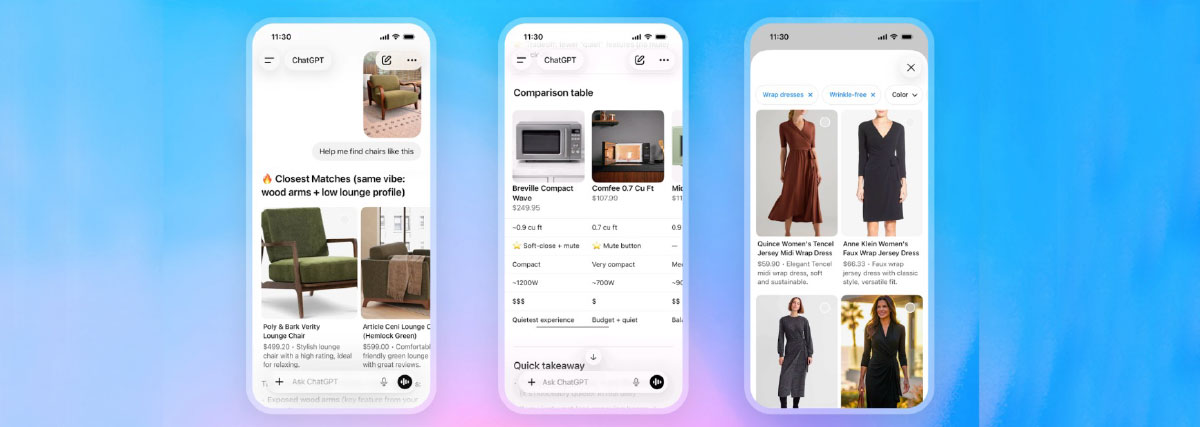
ChatGPT Shopping uses AI to help consumers discover, compare, and evaluate products through a visual shopping experience. Picture source: OpenAI.
Reach was never the same thing as being findable
Every influencer program measures its audience. Almost none of them measure what a creator’s footprint looks like to a machine trying to decide whom to cite. That blind spot is now a real liability, not a hypothetical one.
YOU ASK: “Where is the AI actually getting this from?”
THE MACHINE ANSWERS: “Based on publicly available reviews, community discussions, and video content across the web.”
Translation: not where most influencer budgets live. Reddit alone accounts for 40.1% of citations across AI-generated answers worldwide, Wikipedia for 26.3%, YouTube for 23.5%. Branded content and most publisher sites don’t come close. Old SEO instincts barely transfer either: fewer than 10% of the sources cited by ChatGPT, Gemini, and Copilot rank in the top 10 Google results for the same query.
Which means “owned content” isn’t automatically an asset anymore, it depends entirely on whether a machine can actually get inside it. Take newsletters. On paper, they look like exactly what AI models should love: substantial, text-heavy, written with authority.
In practice, research into how often these platforms actually get cited tells a less flattering story, paywalls, fragmented individual domains, and thin crawl access mean most of that writing simply never reaches the model at all.
The rare creators who do get cited almost always bring outside credibility with them before they ever hit publish, the authority belongs to the person or the media, not the platform they happened to choose.
Brand PR teams need to start briefing for this explicitly. Not every deliverable is equally visible to the systems that increasingly gatekeeper discovery. A rich, keyword-complete YouTube description, a post on an open blog domain, a genuinely useful contribution to a public forum, these get read by machines.
A Reels caption or a 24-hour Story does not, no matter how well it performs today. Both matter. Only one is building an asset that compounds.
Stop hiring reach. Start hiring expertise a machine can recognize
Here’s the part that should genuinely change how brands scout talent, not just how they brief it.
YOU ASK: “Which creator should we brief, the one with 2 million followers or the one with 80,000?”
THE MACHINE ANSWERS: Whichever one it already recognizes as the specific answer to this specific question.
AI systems are rewarding depth over size, and the gap is widening fast. A source’s general domain authority now correlates with AI citation at just 0.18, down from 0.34 two years ago, while how completely that source answers one specific, narrow question correlates at 0.87. The math has flipped: size used to predict citation, and now specificity does.
A creator who covers beauty, fitness, travel, and home decor is competing in four crowded rooms at once, mediocre in each. A creator who has gone deep and stayed consistent on one specific problem becomes the reference point for it, and that’s precisely the pattern these models are built to notice and reward.
That authority travels with the person, across every platform, as long as the story stays consistent. Models are starting to recognize creators the way they recognize brands, as entities tied to specific subjects, wherever those entities show up, and consistent entity information across the web increases citation probability by 28 to 40%.
A creator who is unmistakably “the person who explains marathon recovery” on YouTube, on a blog, and in forum threads becomes one reinforced signal to the model. The same creator spread thin across five platforms with no throughline becomes noise.
Which means the scouting question needs to change. Not “how big is this creator’s following”, but “what is this person unmistakably known for, and does their footprint prove it everywhere a model might go looking?”
The uncomfortable part for CMOs
None of this replaces what already works. Audience fit, creative instinct, real brand chemistry, none of that stops mattering. But most briefs, contracts, and scouting decks are still built entirely around the old scorecard: follower count, engagement rate, past campaign performance. None of those three predict whether a machine can find, read, or trust what a given creator produces.
Add one line to the brief, and mean it: can this creator’s content actually be crawled, and does it hold up as evidence once it’s found? That question belongs next to reach and engagement in every creator evaluation from here on, not filed away in a separate “AI strategy” deck nobody in the room opens.
Treat brand PR support for creators as a paid deliverable, not a courtesy: helping someone turn hands-on expertise into content a machine can parse is now part of what a partnership is for, the same way producing a usable creative asset always was.
And when two creators have comparable audiences, hire the one who is unmistakably known for one specific thing over the one who’s popular for everything, because only one of them is building an asset that compounds every time a model goes looking for an answer.
Organic isn’t dead. Influencers aren’t losing to a robotic player. What’s dying is the idea that any single channel, AI visibility included, can be chased in isolation and still win. The brands still setting the terms of discovery a few years from now won’t be the ones who threw the year’s budget at the newest obsession.
They’ll be the ones who stopped treating AI visibility and human influence as two separate line items, and built one cohesive view of how discovery actually works now, right around the time everyone else was still panicking about not showing up in a chatbot’s answer.
Notice what just happened across these four exchanges. Four ordinary questions, four confident synthesized answers, and by the end you have a fully formed point of view without a single named source anywhere in the middle of it. That is not a trick this article is playing on you. That is the exact mechanic now reshaping how brands get chosen, query by query, category by category.
The only real question left for any brand reading this is whether the evidence underneath its category’s answer already has its name on it, or whether it just spent a year’s budget funding the anonymous proof a machine used to recommend someone else.